
NEW DELHI: With air quality worsening sharply across the Delhi-NCR, authorities on Saturday invoked the strictest restrictions under Stage IV of the Graded Response Action Plan, triggering emergency curbs across the region. This comes hours after implementation of GRAP stage III measured in the national capital region. The Commission for Air Quality Management said its GRAP sub-committee had decided to enforce all measures under Stage IV or ‘Severe+’ air quality with immediate effect after pollution levels crossed critical thresholds. In an official statement, the panel said, “Keeping in view the prevailing trend of air quality and in an effort to prevent further deterioration of air quality in the region, the CAQM Sub-Committee on GRAP decides to invoke all actions as envisaged under Stage-IV of the extant GRAP ‘Severe+’ Air Quality (DELHI AQI > 450), with immediate effect, in the entire NCR.” It added that these steps would be in addition to restrictions already in force under Stages I, II and III. The decision came hours after Delhi slipped back into the ‘severe’ category, prompting the reimposition of Stage III curbs earlier in the day. According to official data, the city’s Air Quality Index, which stood at 349 on Friday evening, surged overnight and was recorded at 401 by Saturday morning due to slow wind speeds, a stable atmosphere and unfavourable meteorological conditions that hampered the dispersion of pollutants.
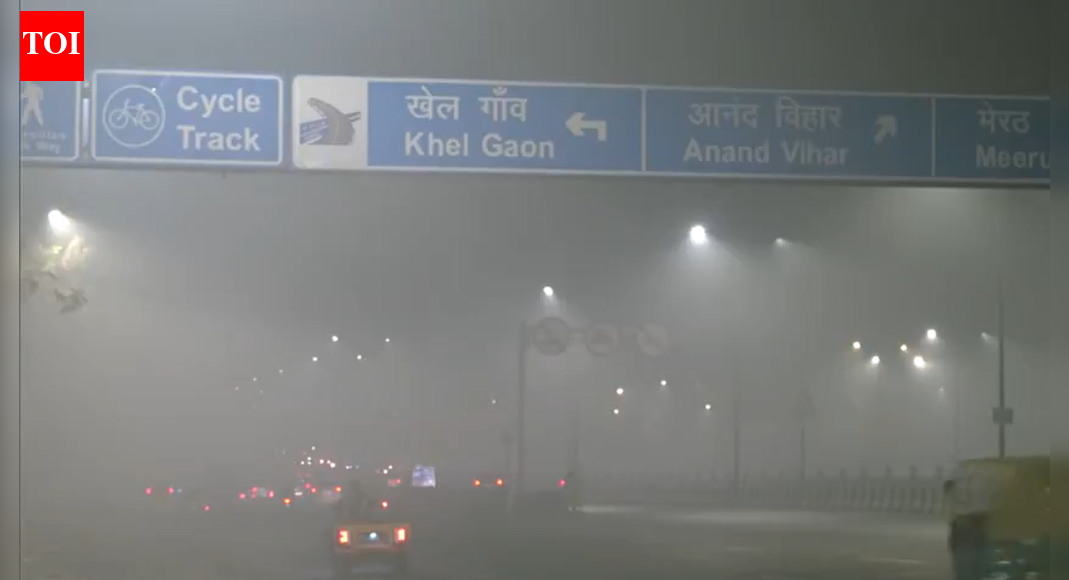
Also read: Delhi AQI turns ‘severe’: GRAP Stage III reimposed across NCR; what’s allowed & what’s notA dense layer of smog enveloped the capital on Saturday morning, reducing visibility and intensifying health concerns. Wazirpur recorded the worst air quality with an AQI of 445, followed by Vivek Vihar at 444, Jahangirpuri at 442 and Anand Vihar at 439. Several other areas, including Rohini, Ashok Vihar, Narela, Mundka and Bawana, also remained in the ‘severe’ range.Poor air quality conditions extended beyond Delhi, with parts of Uttar Pradesh also reporting dense smog. Noida sectors recorded AQI levels of 448, while visibility dropped in cities such as Bulandshahr, Ayodhya and Mainpuri amid fog and haze.Under CPCB norms, an AQI between 401 and 500 is classified as ‘severe’ and poses serious health risks, particularly for children, the elderly and those with respiratory ailments. Authorities have directed enforcement agencies to intensify checks and ensure strict compliance with GRAP measures to prevent further deterioration in air quality.
What is NOT allowed under GRAP 4
Construction and industrial activity
- All construction and demolition activities, including earthwork, excavation, piling and structural work
- Operation of stone crushers, brick kilns, hot mix plants and mining activities
- Industries using coal, furnace oil or other unapproved fuels
Vehicles and transport
- Entry of all diesel-powered medium and heavy goods vehicles into Delhi, except those carrying essential goods
- Operation of BS-III petrol and BS-IV diesel four-wheelers
- Non-essential inter-state diesel buses that are not BS-VI, electric or CNG
Other restrictions
- Use of diesel generator sets, except for emergency and essential services
- Open burning of any kind, including waste and biomass
- Any activity that may increase dust or emissions
What is allowed under GRAP 4
Essential services and infrastructure
- Construction related to essential services such as metro, railways, airports, highways, defence, healthcare and sanitation
- Emergency repair and maintenance works with strict dust control measures
Transport and mobility
- Electric vehicles, CNG vehicles and BS-VI compliant vehicles
- Public transport services, including buses and metro
- Vehicles used by persons with disabilities
Education and offices
- Schools may shift to online or hybrid classes, especially for younger students
- Offices may reduce staff strength and encourage work from home
Utilities and emergency operations
- Power generation units supplying electricity
- Use of diesel generators for hospitals, data centres, telecom services and emergency situations