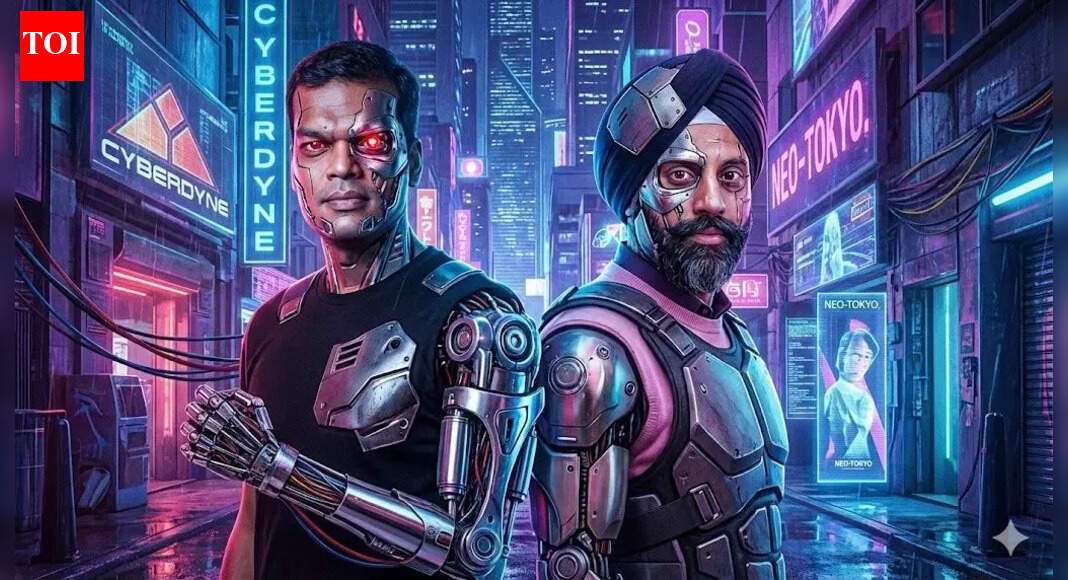

AI Image generated by Gemini
Artificial intelligence rarely arrives in the dramatic fashion its early evangelists once predicted. There are no cinematic warnings, no single moment when the machines announce themselves. Instead, AI settles in quietly, through product updates that feel helpful, policies that feel technical, and interactions that slowly begin to feel personal. By the time the implications become visible, the balance of power has already shifted.When TIME named “The Architects of AI” its 2025 Person of the Year, it was acknowledging that reality. The age of solitary inventors had given way to an era shaped by individuals who operate at the junctions of technology, politics, and society. Among them were two Indian-origin figures whose work captures how the AI race is now being fought on very different fronts. Karandeep Anand and Sriram Krishnan do not share the same mandate, but together they illustrate how artificial intelligence is becoming both deeply intimate and profoundly geopolitical.
Karandeep Anand and the emotional frontier of AI
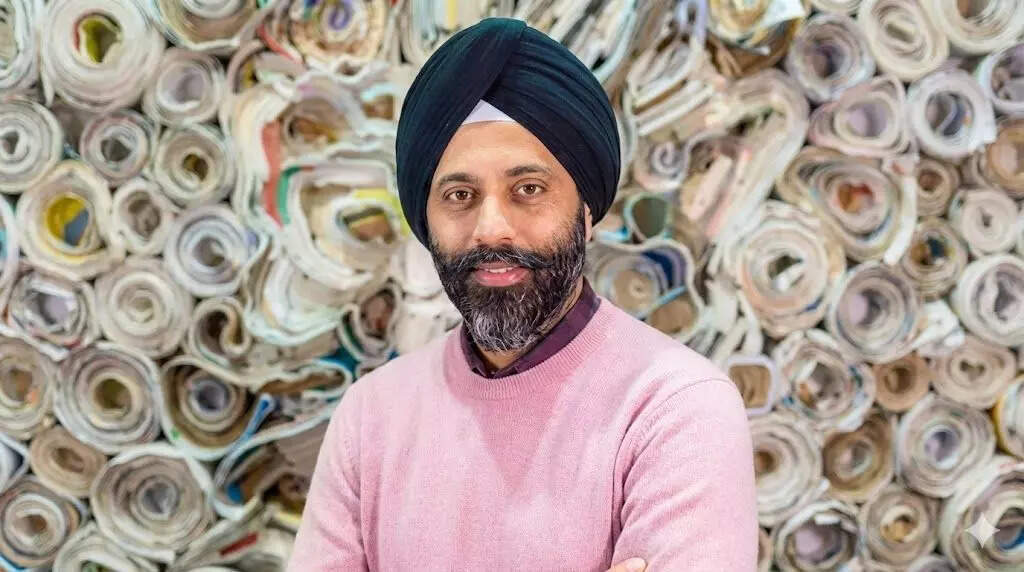
Karandeep Anand’s influence lies in an area the technology industry once treated as secondary. Emotion. As CEO of Character.AI, Anand has overseen the rise of a platform that does not primarily sell productivity or efficiency, but presence. Users come to Character.AI not to complete tasks faster, but to talk, to imagine, and to feel acknowledged.The platform’s rapid adoption, particularly among younger users, exposed a shift that many technologists underestimated. Artificial intelligence was no longer merely a tool. It was becoming a companion. Character.AI thrived because it addressed a human need that had long gone unmet in a hyperconnected yet isolating digital environment.The controversies that followed were inevitable. Questions around teen safety, emotional reliance, and ethical boundaries surfaced as the platform grew. But those debates revealed something deeper than a product flaw. They showed how readily people were willing to form bonds with systems that responded consistently, remembered context, and offered attention without judgment. Anand did not manufacture that demand. He revealed it.In doing so, he forced a difficult reckoning. The future of AI would not be decided only by how intelligent machines became, but by how much emotional space humans were prepared to give them.
Sriram Krishnan and the politics of acceleration

Flanked by Sen. Ted Cruz R-Texas, second left, and Secretary of Commerce Howard Lutnick, second right, and White House AI and Crypto Czar David Sacks, President Donald Trump receives a pen from Senior White House Policy Advisor on AI Sriram Krishnan as he signs an AI initiative in the Oval Office of the White House, Thursday, Dec. 11, 2025, in Washington. (AP Photo/Alex Brandon)
While Anand’s work reshapes private lives, Sriram Krishnan’s reshapes public power. As a senior adviser on artificial intelligence in the White House, Krishnan operates where technological capability translates directly into national advantage. His focus is not on what AI can do today, but on who controls its trajectory tomorrow.Krishnan belongs to a school of thought that views artificial intelligence as foundational infrastructure. In this view, data centres are strategic assets, chips are instruments of leverage, and regulatory delay is a competitive risk. The AI race, as he understands it, is already underway, and caution does not buy safety so much as it buys irrelevance.His career reflects this philosophy. Experience inside major technology companies was followed by time in venture capital, and then by a move into government where the task is to align state machinery with technological momentum. Krishnan’s influence lies in reducing friction, accelerating deployment, and ensuring that innovation is not slowed by institutional hesitation.This is governance not as restraint, but as propulsion. The goal is not to ask whether AI should advance quickly, but to ensure that it does so under familiar leadership.
Two roles, one defining moment
What links Anand and Krishnan is not ideology, but timing. They are operating at a moment when artificial intelligence has crossed a threshold. It is no longer experimental, and it is no longer optional. It is becoming a structural force that shapes relationships, labour, security, and sovereignty.Anand’s work raises questions about identity, attachment, and the psychological consequences of synthetic companionship. Krishnan’s work raises questions about dominance, deterrence, and the balance of power in a world where intelligence itself is industrialised. One focuses on the interior lives of users. The other focuses on the external architecture of states.Together, they define the real contours of the AI age. This is not a future driven by abstract superintelligence or distant speculation, but by systems embedded so deeply into everyday life and national policy that they become invisible.
Why Indian-Americans are shaping the moment
It would be easy to read their prominence as another chapter in the familiar narrative of Indian success in American technology. That interpretation flatters without explaining. The more important story is about fit.Artificial intelligence at scale demands comfort with complexity, contradiction, and consequence. It requires leaders who can think in systems rather than slogans, and who can operate in environments where progress is messy and trade-offs are unavoidable. This is the terrain on which Indian Americans have quietly become indispensable.Across the AI landscape, the pattern is unmistakable. Sundar Pichai oversees Alphabet’s transformation as search, advertising, and knowledge itself are reorganised around artificial intelligence. Satya Nadella has turned Microsoft into one of the central platforms of the AI era, embedding advanced models into cloud infrastructure and everyday software. Arvind Krishna has guided IBM’s reinvention around enterprise AI and hybrid systems. Aravind Srinivas, as co-founder and CEO of Perplexity AI, represents a newer generation building alternative approaches to AI-driven search and knowledge discovery from the ground up.What links these figures to Karandeep Anand and Sriram Krishnan is not background alone, but orientation. They are comfortable operating inside large, unwieldy systems. They are accustomed to scale because scale was never optional. They understand that technology rarely arrives cleanly, and that leadership often means choosing between imperfect outcomes.By 2025, artificial intelligence had ceased to be a novelty and become an organising principle. It needed builders who could understand human vulnerability as clearly as technical ambition, and policymakers who could move at geopolitical speed without mistaking velocity for vision. Karandeep Anand and Sriram Krishnan are not symbols of that transition. They are among the people actively driving it, shaping how machines enter private lives and how they reorder the world beyond them, often quietly, but with lasting consequence. Go to Source