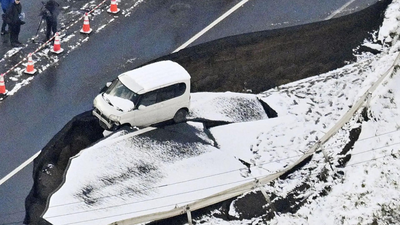
Japan on Wednesday reported 51 people injured after a powerful 7.5-magnitude earthquake struck off the coast of Aomori late Monday, prompting rare warnings of a potentially stronger quake in the coming days.According to the fire and disaster management agency, the updated figure marks a sharp rise from the 30 injuries initially noted by the prime minister on Tuesday. The quake damaged buildings, cracked roads, shattered windows and generated tsunami waves reaching 70 cm.
The Japan meteorological agency (JMA) issued an unusual special advisory early Tuesday, only the second such notice ever, cautioning that another quake of similar or greater magnitude was possible for up to a week. “Due to the occurrence of this earthquake, it is believed that the relative likelihood of a new large-scale earthquake has increased compared to normal times,” the agency said. It warned that a major tremor could trigger a massive tsunami or cause strong shaking in the region.Local media reported that the probability of such an event was estimated at roughly one in 100 over the next seven days. The advisory covers the Sanriku coast and parts of Hokkaido, both facing the Pacific. Japan first issued this type of warning in August 2024 for areas along the Nankai Trough, an 800-km undersea trench where tectonic plates converge. Government assessments suggest a major Nankai quake and tsunami could cause up to 298,000 deaths and $2 trillion in losses. Last year’s advisory, lifted after a week, had triggered panic buying and travel cancellations.Geologists Kyle Bradley and Judith A Hubbard noted this week that while sequences of large earthquakes do occur, predicting them remains impossible. “There was no way to tell whether a strong earthquake will be followed by a similarly strong, or even stronger, one,” they wrote. “Instead, we must rely on historical statistics, which tell us that very few large earthquakes are soon followed by even larger events. It does happen, just not very often,” as quoted by AFP. (With inputs from agency)